The “mini brains” were technically “cerebral organoids,” made from the cells that make up the region of the brain known as the cerebellum. They started out as clusters of stem cells raised in a special medium designed to support brain development, eventually growing into organoids with a similar structure as a real-life cerebellum.
Author: tstadmin
-
What is paneudaimonia?
This paneudaimonia looks like the opposite of panpsychism.
“Paneudaimonia is the idea that the whole universe is absolute pleasure, except in the domain of what we know as sentient beings, in which all experiences imply different types of suffering.
Paneudaimonia is the idea that identity, and / or the “I” and / or consciousness are generated and / or are linked to suffering or pain. That is to say, that the self-consciousness is always painful. But the non-conscious experience (the not self-consciousness) is always pleasurable.
According to the idea “Paneudaimonia”, every time we experience something positive or pleasant, it is because we are losing self or identity; and when we experience the self or the identity, we experience it in a painful way.”
-
Organoids, chimeras and ex vivo tissues
“Organoid” is the term generally used to refer to a small ball of human cells grown in cell culture from stem cells (human stem cells for human organoids). The stem cells may be embryonic stem cells, induced pluripotent stem cells, or other types of stem cells, but the effort has been to get cells that will all become one or more cell types found in an organ. Thus, there are human liver organoids, kidney organoids, gut organoids…and yes, brain organoids. The human neural organoids have been grown for over three years – and some of them have survived for over two years. They have diameters of about 4 millimeters (or a sixth of an inch), about the size of a very small pea. They have no vasculature and so the cells need to be in contact with the oxygen and nutrient bearing (and waste bearing-away) culture media. Currently human neural organoids have about two to six million neurons (no other brain cells so far, just neurons). They self-organize, grow synapses, fire, and continue to get more and more complex as time goes on. Still, by comparison, the human brain is estimated to contain approximately 86 billion neurons.
Chimeras – in this case, human/non-human brain chimeras – are creatures with some human brain cells and some non-human brain cells. (Thus far, in brains at least, they are always non-human animals with some human cells, not humans with some non-human cells.) Chimeras have been used in research for many years, though organoids are opening new possibilities: such as transplanting human organoids into rodent brains – which turn out to grow blood vessels for them.
Researchers have also long used human brain tissue kept alive outside the body – ex vivo tissue – but what is used and how is, like chimeras, becoming “new and improved.” Instead of keeping flat sheets of human brain cells alive in a dish, researchers are keeping alive and studying larger and larger chunks of human brains, taken from neurosurgical discards or from the recently dead. There are even some efforts, so far only in non-humans, to keep whole brains from dead animals “alive” apart from their bodies.
-
List of Animals That Have Passed the Mirror Test
When conducting the mirror test, scientists place a visual marking on an animal’s body, usually with scentless paints, dyes, or stickers. They then observe what happens when the marked animal is placed in front of a mirror. The researchers compare the animal’s reaction to other times when the animal saw itself in the mirror without any markings on its body.
Animals that pass the mirror test will typically adjust their positions so that they can get a better look at the new mark on their body, and may even touch it or try to remove it. They usually pay much more attention to the part of their body that bears a new marking.
Currently, nine non-human animal species pass the mirror test. Not all individuals of each species pass, but many do.
-
Scientists put 3D glasses on cuttlefish and showed them film clips. The results were surprising
The researchers successfully demonstrated that, like humans, cuttlefish brains can compute distance using incoming information from both eyes at once. However, they write in the paper, “Cuttlefish stereopsis is likely afforded by a different algorithm than in humans, and not just a different implementation.
-
Parrots using currency
❝ The birds’ generosity has animal scientists intrigued. It’s one thing to pass a partner a piece of grub; it’s another to give them the currency to purchase it. Such acts of charity have long been thought to be restricted to primates like humans, orangutans and bonobos. Few, if any, other mammals were thought capable of it, let alone a creature with a bird brain.
But big-brained African grey parrots (Psittacus erithacus) may be the first avian known to engage in this helpful behavior, Brucks’ team reports today in the journal Current Biology. Parrots, it seems, don’t just have the ability to comprehend metal rings as currency for food, but they also “understand the consequences their actions can have on another individual,” says Christina Riehl, an expert in bird behavior at Princeton University who wasn’t involved in the research. “That’s pretty sophisticated reasoning.” ❞
https://www.smithsonianmag.com/science-nature/parrots-share-currency-help-their-pals-purchase-food-180973917/?utm_source=facebook.com&utm_medium=socialmedia&fbclid=IwAR2dcTMcb4AhTWYMUjU6N8ZiAAZ5Zt-g1uTgF5Z2JXkdnehTXf913RNbxI8 -
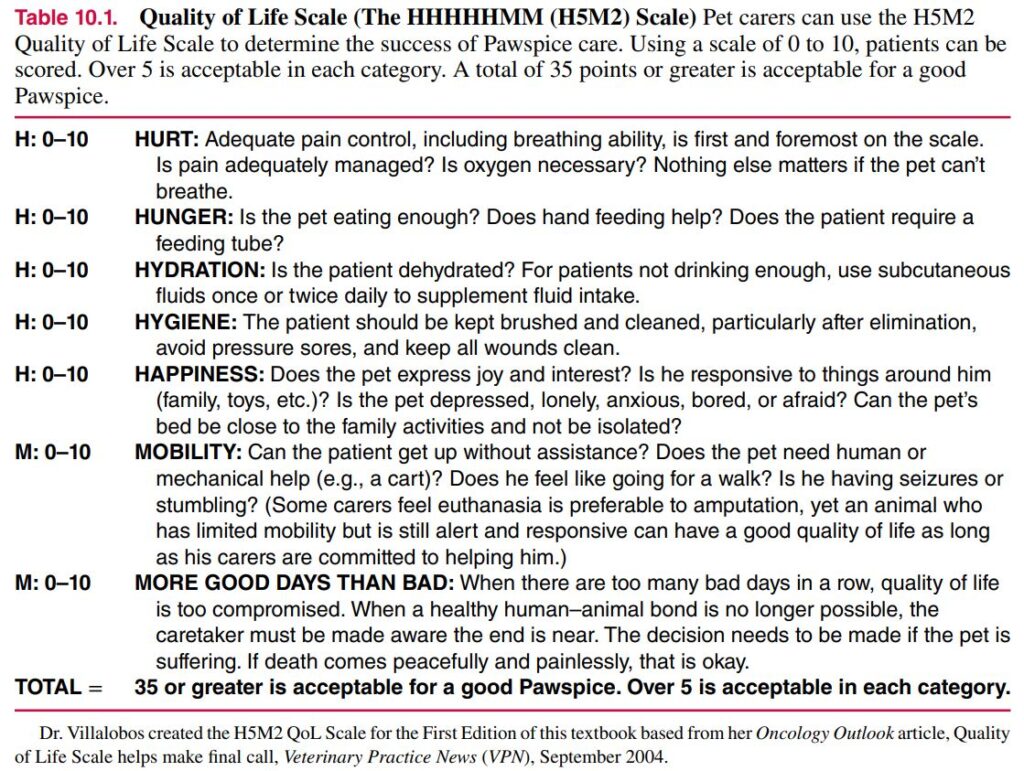
The HHHHHMM (H5M2) Quality of Life Scale
“The HHHHHMM (H5M2) Quality of Life Scale provides guidelines for the assessment of a pet so that pet owners can maintain a rewarding relationship that nurtures the human–animal bond, while being confident that the pet is well enough to justify prolonging life. This Quality of Life Scale will relieve guilt feelings and engender the support of the veterinary team to actively help in the care and decision making for Pawspice patients. I feel that it is ethical to prolong a life worth living. On the other hand, I feel that it is not ethical to prolong death for our patients.”
-
A biomaterial that arrange itself
“Using DASH, the Cornell engineers created a biomaterial that can autonomously emerge from its nanoscale building blocks and arrange itself – first into polymers and eventually mesoscale shapes. Starting from a 55-nucleotide base seed sequence, the DNA molecules were multiplied hundreds of thousands times, creating chains of repeating DNA a few millimeters in size. The reaction solution was then injected in a microfluidic device that provided a liquid flow of energy and the necessary building blocks for biosynthesis.”
-
What are the different types of elements that constitute reality in its most essential aspect?
“If we want to develop a sentience simulation project, that admits as many hypotheses and theories about sentience as possible, we will find that obviously in such an environment it will not be enough to represent the sentience alone, but surely we will have to include other types of substances that may be related to it. To give a very simple example, if we consider that sentience emerges from a wet biological animal material brain, and we want to represent a living frog that feels in our system, the simulation environment must support the representation, in one way or another, of at least two types of objects or concepts: material objects (such as the frog’s brain or whole body and the physical environment where it lives) and sentient objects (such as the frog’s experiences).
Because of this, when simulating sentience, elements that are not purely sentience should generally also be simulated; and if we want to have an environment that admits all possible hypotheses and theories about sentience, then to be very sure of leaving nothing out, it would be very interesting to be able to include as types of simulation objects all kinds of possible components of reality according to all kinds of paradigms, theories and beliefs.”
-
God or consciousness?
A quote from Max Planck:
“All matter originates and exists only by virtue of a force which brings the particle of an atom to vibration and holds this most minute solar system of the atom together. We must assume behind this force the existence of a conscious and intelligent mind. This mind is the matrix of all matter.”
https://www.goodreads.com/quotes/1328821-all-matter-originates-and-exists-only-by-virtue-of-a
What is Max Planck talking about? Consciousness? Sentience? Panpsychism? God?